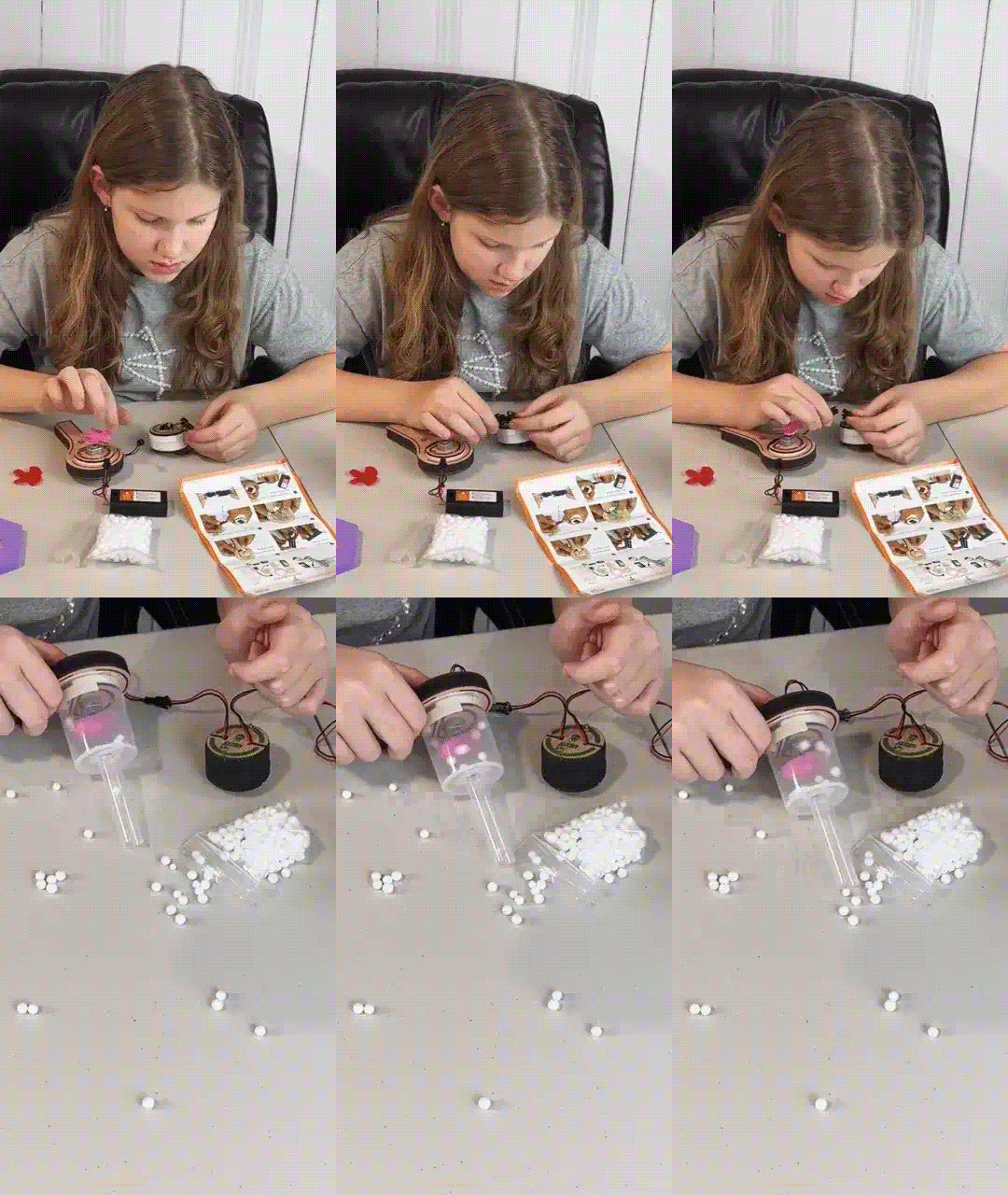
Introduction:
Sound is an intriguing and fundamental concept in physics. It travels in the form of
waves and has properties such as frequency and amplitude. Engage your students or
children in hands-on learning experiences with these DIY activities to deepen their
understanding of sound and its characteristics.
Activity 1: Slinky Sound Waves
Materials Required:
Slinky
Procedure:
Hold the slinky with both hands and stretch it out.
Give a sudden push to one end of the slinky in a specific direction.
Observe the motion of the slinky as the wave travels through it.
Notice how the wave propagates through the slinky, demonstrating how sound travels through different mediums.
Science Behind:
The slinky activity helps visualize how sound travels as a wave. The sudden push creates a compression and rarefaction effect, simulating the oscillations of particles in a medium. This demonstrates the longitudinal nature of sound waves, where particles vibrate parallel to the direction of wave propagation.
Activity 2: Frequency Visualization
Materials Required:
Bending straws, tight straw, tape
Procedure:
Create a sleeve by attaching two bending straws together.
Slide a tight straw into the sleeve, securing it with tape.
Observe the curved shape formed by the bending straws and identify the regions of the curve corresponding to the frequency of the sound wave.
Science behind:
In this activity, the bending straws represent the compression and rarefaction regions of a sound wave. By observing the curves, students can visualize the variation in pressure caused by different frequencies. Higher frequencies will result in more compressed curves, while lower frequencies will have more spaced-out curves.
Activity 3: Wavelength Visualization
Materials Required:
Bending straws, tight straw, tape
Procedure:
Repeat the steps from Activity 2 to create the sleeve and insert the tight straw.
Observe the entire length of the bending straws, from one end to the other.
Identify the distance between consecutive curves and relate it to the wavelength of the sound wave.
Science Behind:
The bending straws in this activity represent the complete cycle of a sound wave, from compression to rarefaction and back. By measuring the distance between curves, students can visualize the wavelength of the sound wave. Longer wavelengths will have more significant distances between the curves, while shorter wavelengths will have smaller distances.
Instruction video on Activity -1, 2 and 3
Activity 4: Wave Generator
Materials Required:
Eva foam sheets, threads, battery, battery holder, small bead with a hole, motor, small stick
Procedure:
Construct a wave generator using the provided materials.
Ensure the motor is securely attached to the foam sheet.
Switch on the motor to generate waves in the foam sheet.
Observe the wave patterns and note any changes in frequency and wavelength by adjusting the motor speed.
Science Behind:
The wave generator stimulates the production of sound waves. As the motor rotates, it creates disturbances in the foam sheet, generating waves. By manipulating the motor speed, students can observe how changes in frequency and amplitude affect the resulting wave patterns. This activity provides a visual representation of how frequency and wavelength are connected in sound waves.
Quick understanding on Sound - Frequency & Amplitude
Journey into the Sonic Realm: Engaging DIY
Experiments for Explorers of Sound!
These DIY activities offer hands-on experiences to explore the concepts of sound, specifically focusing on frequency and amplitude. By engaging in these interactive experiments, students and children can deepen their understanding of sound as a wave phenomenon and gain insights into the science behind it. Have fun exploring the fascinating world of sound!