Engaging DIY Activities to Teach and Demonstrate Visualizing Solid Shapes
Introduction:
Welcome, high school teachers and homeschooling parents! In this blog post, we will explore a variety of exciting do-it-yourself (DIY) activities to help students understand and visualize solid shapes. These hands-on projects are designed to engage students' creativity while enhancing their understanding of concepts related to 2D and 3D shapes. Let's dive in!
where do we need to visualize the solid shapes? In many fields, professionals need to visualize 3-dimensional shapes to do their work3 For example, animators who make movie and video objects into simpler solid down complicated shapes like cylinders, spheres,etc. A bowlers swing action is shown here by animating his arm and the ball,
From excavation sites, Archaeologists reconstruct ancient buildings and towns by visualizing their walls, Structures, common areas, etc.
From fossils, paleontologists reconstruct animals’ bodies and structures using 3d shapes of their bones, muscles and movements
In criminal investigations, bodies of victims by forensic experts reconstruct faces and bodies of victim by visualizing their facial structures and shapes
Activity 1: 2D Object Rotation
Materials Required:
Foam sheets (various shapes)
mortar
battery
wire.
Procedure:
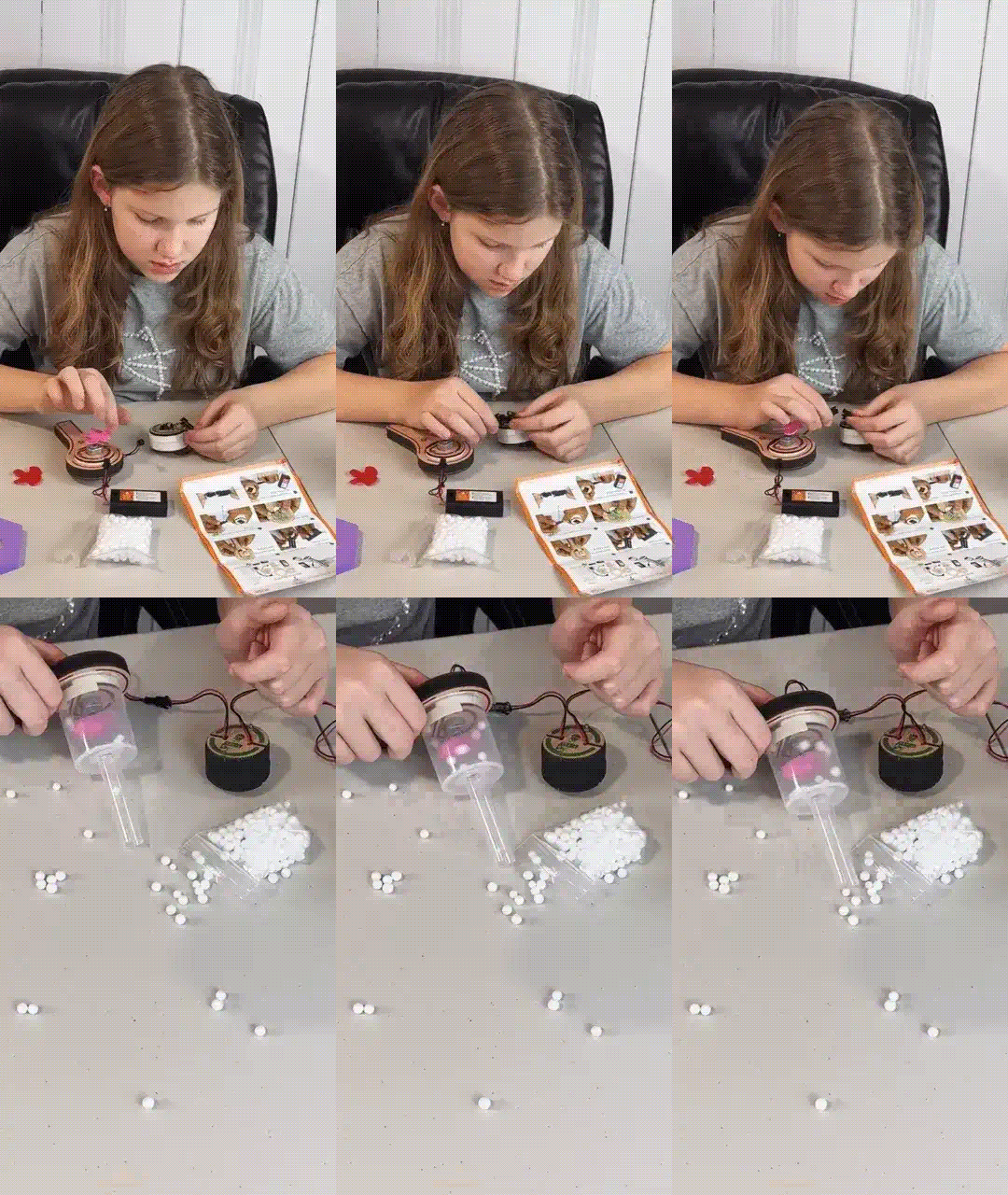
In this activity, students will create a model using foam sheet shapes, mortar, a battery, and wire.
Encourage them to construct different shapes by cutting the foam sheets into squares, triangles, circles, and more.
Then, attach the foam shapes to the wire frame and connect it to the battery.
As students rotate the model, they will observe how the 2D shapes change in relation to their perspective, highlighting the concept of rotation.
Activity 2: Reconstruct from Piece
Materials Required:
3 mirrors
tape
foam pieces.
Procedure:
Using mirrors, tape, and foam pieces, students will construct a model that demonstrates the reconstruction of a whole shape from its individual pieces.
Instruct them to arrange the mirrors in a way that allows the reflections to create the illusion of a complete shape.
Then, place the foam pieces strategically to complete the reflection puzzle. This activity encourages students to understand how 2D reflections can lead to the formation of a 3D shape.
Activity 3: 3D Shapes from Net Diagrams
Materials Required:
Papers
scissors
folding techniques.
Procedure:
Challenge students to make 3D shapes from net diagrams and explore Euler’s formula.
Provide pre-drawn net diagrams of various shapes like cubes, pyramids, and prisms.
Instruct students to cut out the diagrams, fold along the designated lines, and secure the edges with glue or tape.
After constructing the shapes, guide them to determine if the shapes adhere to Euler’s formula.
This activity strengthens their understanding of 3D shape construction and mathematical principles.
Activity 4: Top, Front & Side View
Materials Required:
Plastic cubes
paper
light source.
Procedure:
Using plastic cubes, have students create different shapes by stacking and arranging them on a flat surface.
Place a sheet of paper behind the shape and project a light source onto it. Ask students to observe the shadows cast on the paper from different angles.
This activity will help them visualize the relationship between the top, front, and side views of a 3D shape.
Activity 5: Hologram Effect
Materials Required:
Transparent sheet,
tape.
Procedure:
Guide students in creating a model that demonstrates the hologram effect.
Instruct them to cut a transparent sheet into a specific shape, such as a pyramid or cube.
Then, carefully tape the edges of the sheet together, creating a 3D structure.
By placing the model on a flat surface and shining a light source through it, students will observe the captivating holographic projection created by the transparent sheet.
₹1,199.00Original price was: ₹1,199.00.₹799.00Current price is: ₹799.00.Add to Cart
Quick understanding pic
Conclusion: By incorporating these DIY activities into your lessons, you can provide an engaging and interactive learning experience for high school students or homeschooling children. These hands-on projects will enhance their understanding of visualizing solid shapes, making the concepts come to life in a fun and tangible way. Enjoy exploring the wonders of geometry and fostering a deeper understanding of shapes!