Exploring Microorganisms:
DIY Activity Ideas for High School Teachers & Homeschooling Parents
Introduction:
Welcome to our DIY activity blog post designed specifically for high school teachers and homeschooling parents. Today, we will delve into the fascinating world of microorganisms and explore two engaging activities that will captivate your students or children. Get ready to unlock the wonders of microorganisms and learn about their roles as both friends and foes.
Microorganisms or microbes are tiny microscopic organisms which cannot be seen with the naked eye. They are present almost everywhere and can be classified into four major groups : Bacteria: eg – Cyanobacteria, lactobacillus. Fungi: eg – Yeast, mushroom. Algae: eg – Spirogyra, Blue-green algae. Protozoa: eg – Amoeba, Paramecium.
Bacteria
Fungi
Protozoa
Algae
Pathogen
Diseases
Bacteria
Tuberculosis, Typhod, Cholera
Virus
Measles,Chicken pox,Polio, Hepatitis A
Protozoa
Malaria
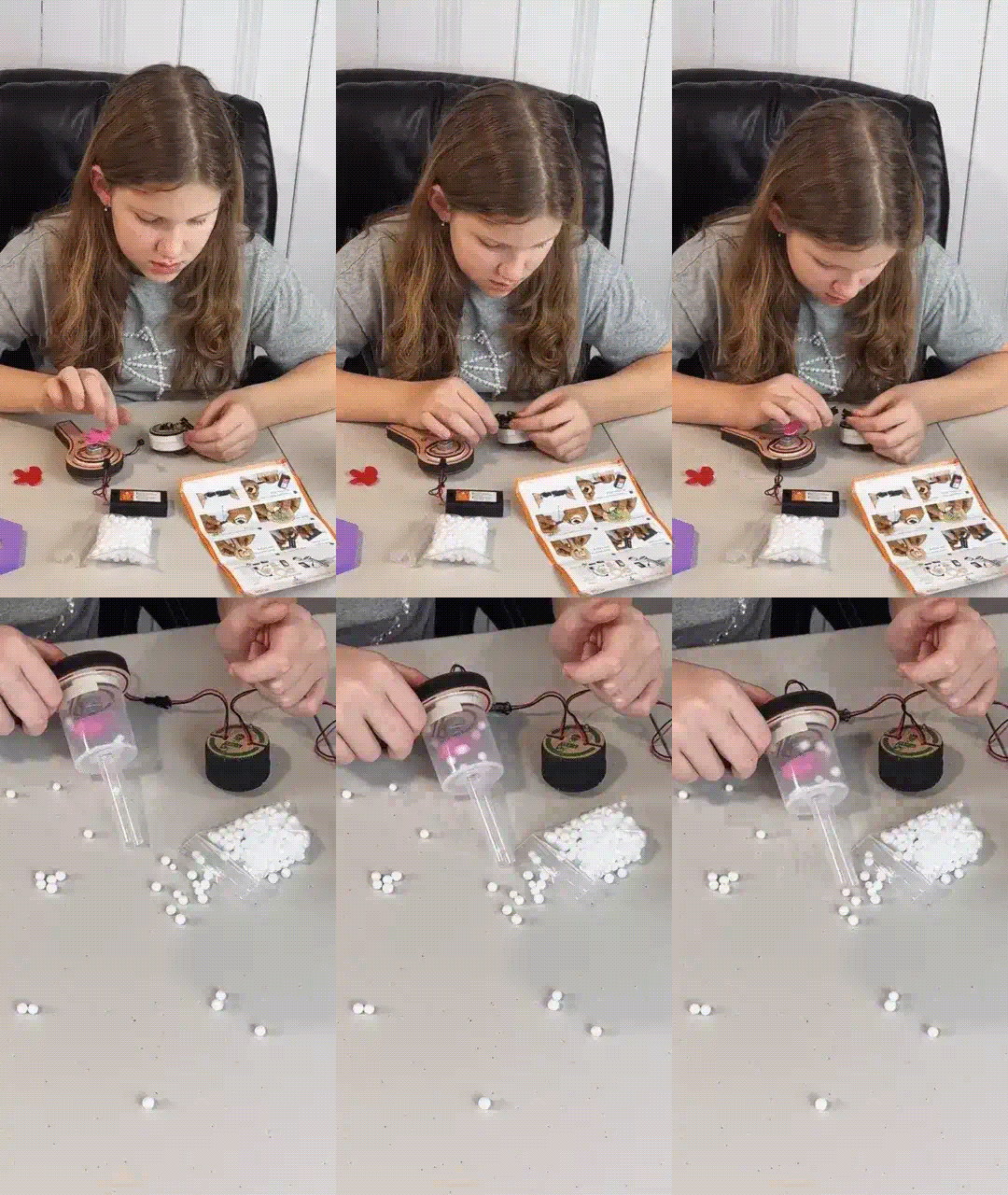
Activity 1:Virus Replication Model
Materials Required:
Rectangular sheet with rounded corners (represents the host cell)
G-charge foam double-sided tape
Transparent paper
Metal balls
Scissors
Marker
Glue
Procedure:
Begin by creating the host cell. Take the rectangular sheet and attach g-charge foam double-sided tape on one side, leaving gaps in the middle.
Cut out a virus shape from a separate sheet of paper. Attach a small rectangular bar at the bottom of the virus to represent the connection with the host cell.
Attach g-charge double tape on the sides of the virus shape, leaving a gap on the head of the virus.
Cut the transparent paper into the shape of a host cell, making sure to remove a rectangle piece near one of the small sides. Attach the virus shape to the host cell and the transparent paper using the double-sided tape.
Fold the transparent paper into a cube shape and insert it into the rectangle space of the host cell to represent the nucleus.
Take the metal balls, representing the viral RNA, and attach them to the virus in the small side gap.
Insert two strips of sheet into the gaps on the larger sides, crossing each other.
Drop the metal balls into the nucleus. As the nucleus is removed, the RNA falls into the first strip, representing virus replication. Remove the second strip to demonstrate the assembly of virus RNA.
Finally, remove the strips to reveal that the assembled virus cells have entered the host cell.
Observation Questions:
Step in the Activity vs What does it represent?
Step in the Activity
What does it Represent?
Metal balls inside the white box
Dropping the metal balls from the top
Pulling the box out
What's happening?
Activity 2: 2D Microorganism Structure Jigsaw
Materials Required:
Construction paper or cardstock
Markers or colored pencils
Scissors
Puzzle template (optional)
Glue (optional)
Procedure:
Choose paramecium and bacillus microorganisms for this activity.
Draw the outlines of their structures on construction paper or cardstock.
Divide the structures into puzzle-like pieces by drawing lines across the outlines. You can use a pre-made puzzle template for guidance or create your own unique design.
Cut along the lines to separate the pieces.
Optional: Color and label each piece to highlight specific features of the microorganisms.
Mix up the puzzle pieces and challenge your students or children to assemble the microorganisms by matching the pieces together.
As they work on the puzzle, encourage them to observe and compare the similarities and differences in the structures of paramecium and bacillus.
3D Microorganism Structure
Materials Required:
Foam board, Beads, Styrofoam balls (different sizes), Pipe cleaners, Craft paper or cardstock, Glue, Scissors, Markers or colored pencils, m, and long straws (for Activity 1: Straw Towers), Small, medium and big Rings (for Activity 2: Grouping Ring Counting)
Procedure:
Start by identifying and discussing the main components of a bacteriophage virus, such as the head, tail, and tail fibers.
Use the styrofoam balls to represent the different parts of the bacteriophage virus. For example, a larger styrofoam ball can be used as the head, while smaller balls can be used for the tail and tail fibers.
Cut and shape the pipe cleaners to create the tail and tail fibers. Attach them to the appropriate styrofoam balls using glue.
Use craft paper or cardstock to create any additional structures, such as the capsid or other specific features, and attach them to the model.
Use markers or colored pencils to add details and color to the model, making it more visually appealing and accurate.
Discuss the functions of each component of the bacteriophage virus as you assemble the model.
Observation Questions:
Identify the category to which the organisms you obtained below. Paramecium – ________ Bacillus – ________ Bacteriophage – _____
How is the outer covering of the structures you studied different from each other?
Identify the Characteristic in the organisms you observed.
₹1,199.00Original price was: ₹1,199.00.₹799.00Current price is: ₹799.00.Add to Cart
Quick understanding on Micro-Organisms
Conclusion: Microorganisms are diverse and fascinating, each with their own unique structures and processes. Through these engaging DIY activities, you have explored the process of virus replication, created a 2D jigsaw puzzle to study the structures of paramecium and bacillus, and constructed a 3D model of a bacteriophage virus. These hands-on experiences will not only enhance understanding but also foster critical thinking and scientific exploration among high school students and homeschoolers. Enjoy the adventure of discovering the wonders of the microscopic world in your classroom or home!